Showing posts with label Prague Castle. Show all posts

Monday, April 22, 2013

Meanwhile, back at the castle


Armed with a ticket for the works, I spent all of today's tourist time at Prague Castle.  First stop was a return visit to St. Vitus' Cathedral, but this time my ticket let me explore all of it that is open to the public.

The stained-glass windows are generally nice, though not my favorites.

Click on any image to see a larger version.

The one Mucha designed, however, is absolutely gorgeous.


Paintings, frescoes, and tapestries adorned the many small chapels inside the church, but none were labeled.  Some looked like relatively new additions, while others, such as this one, felt quite old and were often in a bit of disrepair.


Everywhere you go here, you get the sense of a land that has spent much of the last many centuries under various kinds of renovation, some by choice, others by necessity.  Without actually getting to know any Czechs, I've come to admire the resilience of these people.

St. Vitus' houses many tombs, all decorated but some far more ornate more than others.  


This one, which was nearest the front of the church, was clearly of great importance--and so big I couldn't get it all in one shot.  (It proved to be the tomb of St. John of Nepomuk; the tomb alone contains two tons of baroque silver.)  Just this much, though, should give you a sense of how ornate it was.


The most completely decorated room in the place was cordoned off, so I had to settle for an exterior shot.  I have no clue what made it special, but I would like to have been able to study it further.


Did I mention the organ?


I was interested and pleased to see this memorial book for lost Czech airmen.


I also quite liked this mosaic.


Wandering through the gift shop, which I routinely do though I've yet to buy anything in one, I couldn't help but notice the copyright on this bit of Kafka merch.
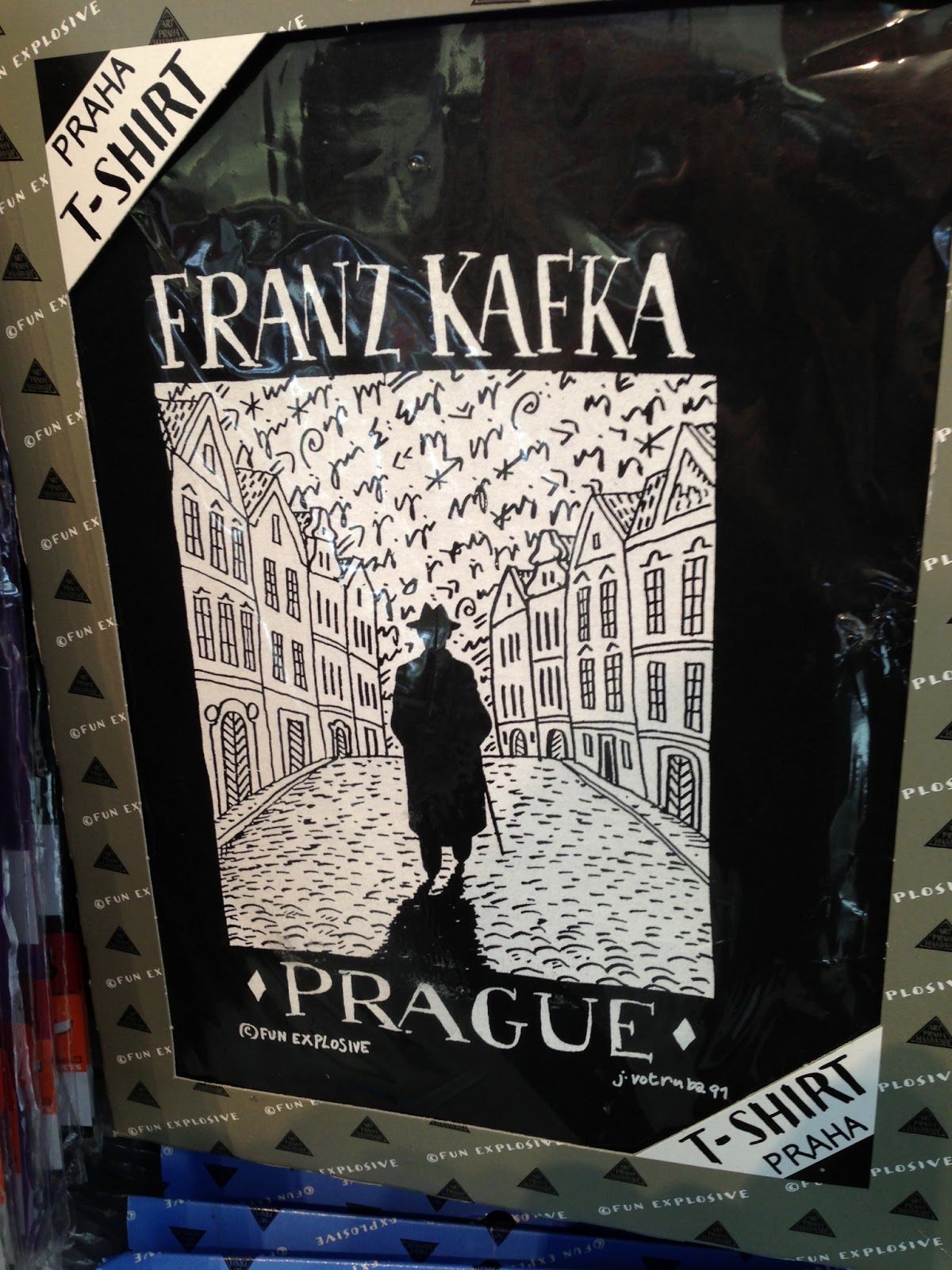

Ah, you have to love unintentional humor. 

Another key stop today was the Picture Gallery.  Centuries ago, it housed the collection of Rudolph II and was one of the world's great art assemblages.  Various wars and conquerors subsequently left it empty.  What's there today has all arrived in the last hundred years or so.  The result is that it contains some interesting works but is just not up to the level of the many galleries I've seen on this trip.

I did like this piece by Bartholomeus Spranger.


Guards were everywhere, and the place does not allow photography, so I didn't take many pictures.  Still, I couldn't resist this nifty teaching tool for the above painting.


Lift any of the pieces with handles, and text inside points out the symbols and other interesting facts about that section of the work. 

I would love to get Google to pay me to create a team to do this with Google Glass for all of the great works of art of the world.  Forget audio guides; imagine augmented reality with visual and auditory input under your control.  It would be awesome.

An unusual work was this illusionist triple portrait of Rudolph by Paulus Roy.


From the little I've read on this subject, it appears that Rudolph enjoyed this sort of thing.  

The collection did include some work by major artists, including this Holbein.


Most of those pieces, though, were either obviously minor or the work of the artist and his studio, with the studio's contributions frequently obvious and not up to the work of the master involved.

I had not before noticed any work by Lucio Massari, but this one was lovely and very well done.


This Veronese also stood out and was an exception to my above observation about the bigger names in the gallery.


I was not previously familiar with the paintings of Pauwels Franck, better known as Paolo Fiammingo, but the odd imagery in this one--note the frog man with hat in the lower left corner--really struck me.


I'll be on the lookout for more of the work of this man who studied under Tintoretto but who clearly pursued his own vision. 

The Treasury of St. Vitus is small and forbids photographs, but it is well worth a stop.  Its intriguing sets of reliquaries and moniles (reliquary pendants that church officials wore) were worth the cost of admission.  This reliquary of the arm of St. George is cool indeed.


The creators of this reliquary had so many bits and pieces of St. Martin that they built an entire panel of them!


On the way to a quick tour of the small history of the palace honor guard (okay but not particularly noteworthy), I passed this odd structure.


No sign explains it, and no one seemed to notice it.  I liked it.

St. Vitus' from the back.


The Basilica of St. George, the oldest church on the property, from the front.


This church started in the 900s and has been through many iterations since then.  The building is in rough shape but is nonetheless fun to visit.  Some very old frescoes remain and are of interest.


An armory exhibit nearby mostly showcased one suit of armor after another, but its real tourist attraction was this room full of torture devices.


Though they were clearly crammed into one space to appeal to tourists, the presence of the devices makes sense given that a prison stands adjacent to the armory.

At this end of the castle, another path leads down to the city, so of course I had to take it.  Wandering vaguely toward the hotel, the path passed by an opening to the Vojan Gardens.  Though there was only one way in and out, and thunderclouds were gathering overhead, I had to check it out; you can't ignore a garden you encounter by happenstance. 

I'm very glad I did.  It was lovely, with a small pond, people resting on the ground and on benches, and many beautiful trees, including this magnolia.


An added treat was the surprise appearance by this peahen


and this peacock, who chose to pose between two dumpsters for my camera.


I have no clue if this bookstore is related to the one in Paris, but seeing it made me smile.


Tomorrow is likely to take me on an unusual ride.  Stay tuned!


Saturday, April 20, 2013

Churches and a castle


Though a light drizzle was falling, I decided today was not going to be the lazy day.  Maybe tomorrow, depending on the weather and how I feel.  I'll figure it out then.

Today instead turned into reconnoiter-Prague-Castle day.  The castle is fairly close to the hotel as the crow flies, but the crow doesn't have to walk up the hill.  Cabs can take you there, but that wouldn't be in the walking spirit of this trip, so with a pause for a quick lunch, in the early afternoon I walked the streets and switchback to the castle.

Along the way, I finally found myself at the front door of the church in some of my first Prague photos.  It proved to be the St. Nicholas Church, a baroque wonder.  The first version of the church came online in the late thirteenth century.  In the middle of the eighteenth century, a rebuilding project incorporated a Roman rotunda from the nearby church of St. Wenceslas.

The combination of the baroque architecture and the rotunda is quite stunning. 

Click on any image to see a larger version.

Every aspect of this place was highly decorated, frequently with images of saints and bishops and other clergy or people of significance; I could not identify them all.  The ceiling was simpler than Italian church ceilings but still cool.


The side chapels were consistently lovely as well, as you can see in this shot that includes two


and in this image of one of them.


I particularly liked the tombs under a few of the side chapel altars, such as this one.


The rear of the church wasn't too shabby. 


Nor was this pulpit.


Maybe Bill and I need a pair of these for PT company meetings.

Nah, probably not. 

The main altar was heavy on St. Nick and lighter on Jesus than I had expected.


As I walked around and examined the paintings and statues, once again the new-old nature of Prague became very clear.  Most of items were more recent than a quick glance might suggest, no doubt due to rebuilding after damage from time and/or wars. 

Prague is a city always reinventing itself, in dialog with itself, melding the fading and sometimes destroyed past with the present to create a new, always changing version of itself.

In this church, if you climbed a winding staircase to the gallery, you could see the ten original old paintings that it still contains.  Signs dated all of them from 1672 to 1674, but nothing said who painted them.  I found them generally good but no more.  Most moving, to me, was this Pieta


On the way up to the castle, I got a good, close look at some roofs for the first time.  It was interesting to see that whether the tiles were flat or curved varied, at least in this area, from house to house, not neighborhood to neighborhood, as I'd thought I'd previously observed in other areas.


The views from beside the castle were spectacular.  As a young American woman leading some friends up the street said, "And here's where it gets breathtaking."


People were everywhere, enjoying the day despite the occasional drizzle and the cold, staring at the castle, walking, talking, playing, laughing, thinking, in groups and alone, all united by the desire to see this set of national treasures.  A cellist (far away in this photo) filled the square with lovely music.


As if they were alone in the world, a man petted and stroked a dog who had eyes only for him, and then stopped, straightened, and stared into the distance as if a ghost had called his name, the dog waiting patiently beside him.  


Inside the castle grounds, the gothic St. Vitus' Cathedral towered over everything.


Up close, it was more impressive and more lovely. 


Today was reconnoitering day, so I did not buy any castle tickets.  That meant I could enter St. Vitus but had to stay in a small area.  I'll go back, probably on Monday, but even this glimpse inside made clear that this was a serious gothic church.


I assume I'll have more for you then on this lovely old building.

Outside, I wandered over a bridge across a deer moat.


I have a freakish inability to remember plant names, but I still sometimes enjoy strolling through gardens, so I wandered the castle gardens today.


They were not ornate, but they were well tended and lovely--and they had signs identifying quite a few of the trees, which I very much appreciated.  I was particularly interested in this dawn redwood, a tree, the sign explained, that was once thought to be extinct until discovered in Sichuan in 1941.  An American expedition in 1949 gathered seeds there and distributed them to many leading botanical gardens.  This tree is from one of those seeds.


The walk uphill brought me in on one side of the grounds, so I naturally descended via the stairs on the other side.  Here's the view uphill at about a third of the way down.


The view in the other direction.


Taking a different path back to the hotel, I couldn't resist stopping by the John Lennon Wall, which is on a wall of the Anglo-American University.


As you can tell, many of the contributions have nothing to do with Lennon, and from the way some of my fellow visitors were talking, not all of them knew or cared much about him.

Some, though, did, and I did, and that was more than enough for me.


The Lennon contribution in the middle of the above photo is clear.  To the left of it, midway down the picture, are these lines:
THE UNDERTOW'S A BLESSING
AND OUR BRUISES BLOOM LIKE WORKS OF ART
I don't know who wrote that, or even if someone wrote it for this wall, but I like it. 

This image with lyrics from "Because" also was lovely, particularly from a bit of a distance. 


On an entirely mundane note, Prague stores offer Lays chips with grilled bacon!


They were, predictably, yummy.


Labels

Blog Archive